
By Justin Mabeya1, David Karanja2, Vicky Korir2, Eileen Inyanji1, Jean Claude Rubyogo1, Anne Ngugi2, Wincaster Makoani2
1Alliance of Bioversity International and CIAT/PABRA
2 Kenya Agricultural and Livestock Research Organization (KALRO)
In Kenya’s farms, change is arriving without fanfare, but humbly in a small packet of seed passed from an extension officer to a farmer, who is trying something different.
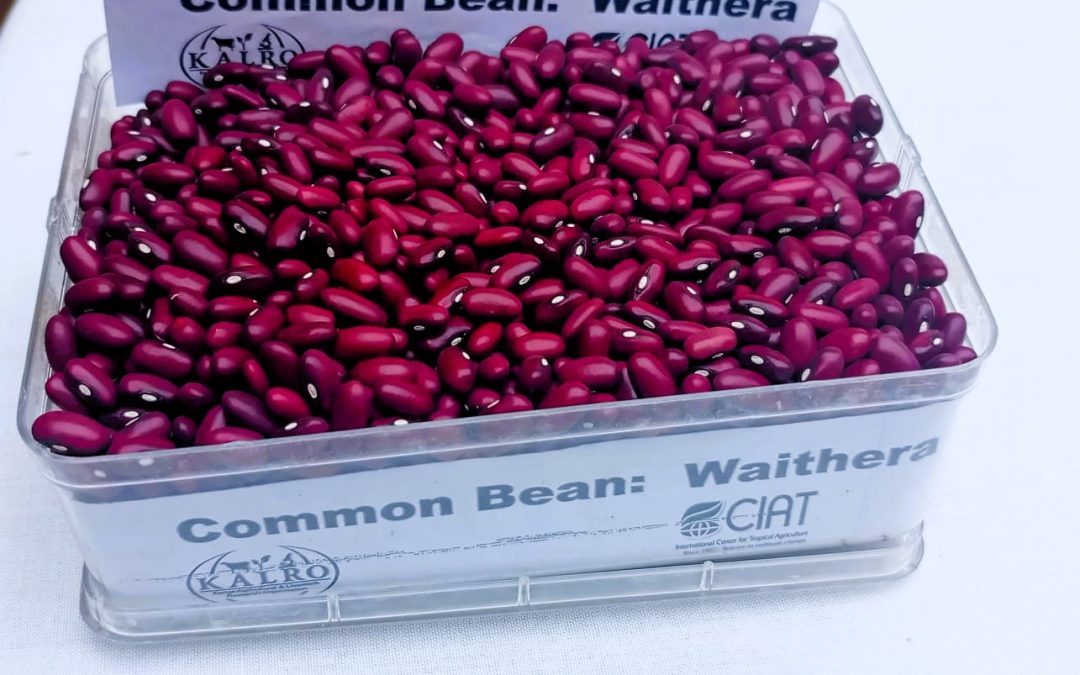
That is how Waithera, a local name symbolizing “abundance”, is entering the country’s bean fields.
Developed through a long-standing partnership between the Kenya Agricultural and Livestock Research Organization (KALRO) and the Pan-Africa Bean Research Alliance (PABRA) program of the Alliance of Bioversity International and CIAT, Waithera is being positioned to replace the widely adopted Wairimu variety, while refining its weaknesses and retaining the traits farmers already value.
At KALRO Katumani, researchers describe it as a “re-engineered” bean, which is familiar in the kitchen but more productive in the field. It cooks faster, tolerates drought better, and delivers higher yields. It is also sweeter and produces less flatulence, a small but decisive detail in household conversations that often determines whether the variety is accepted or rejected.
“The Waithera variety retains the desirable characteristics of the Wairimu bean but is specifically bred to produce less gas, offering a more comfortable consumption experience while maintaining the familiar colour after cooking,” said David Karanja, KALRO’s National Coordinator for Grain Legumes. “It cooks fast, is sweet, and contains medium levels of zinc and iron.”
Those nutritional gains matter in a country where beans are a daily staple and a key source of micronutrients for millions of households, especially women and children.
A yield story hard to ignore
If nutrition explains the need for Waithera, yield is what is driving the excitement. Under optimal conditions, Nyota, introduced in 2017, can return about 26 kilograms for every one kilogram of seed planted. Waithera more than doubles that. In trials and farmer-managed plots, it has reached as high as 55 kilograms from just one kilogram of seed.
In Narumoru, Kieni East, Nyeri County, farmers trained by KALRO are already reporting yield in high volumes, coinciding with what researchers describe as “exceptional responsiveness” to good management: adequate soil fertility, timely planting, and proper spacing translate directly into higher pod formation and sustained production. In a country where beans are second only to maize as a staple food, those figures could mean more food on the table and more money in farmers’ pockets.
What the demonstrations showed in Nakuru
Between April and September 2025, on-farm demonstrations across Nakuru County tested Waithera alongside Nyota and Angaza under real farming conditions. Farmers received 0.5 kg of seed per variety and managed them on their own land, with technical backstopping.
The results were uneven across locations but consistently revealing. In Mosop Ward, Angaza recorded the highest single return at 19 kg from 0.5 kg of seed. Waithera followed closely, delivering up to 18 kg under the same conditions, while Nyota trailed at 11 kg.
Table 1: Performance of bean varieties across Rongai sub-County, Nakuru County, Kenya (Planted 8th April 2025, Harvested 5th July 2025)
| Ward Name | Variety | Quantity Planted (kg) | Yield (kg) per 0.5kg | Yield for 1kg (kg) | Remarks |
| Mosop | Angaza | 0.5 | 19 | 38 | Angaza performed well |
| Mosop | Nyota | 0.5 | 11 | 22 | Stable performance |
| Mosop | Waithera | 0.5 | 18 | 36 | Consistent high yield |
| Visoi | Waithera | 0.5 | 13 | 26 | Preferred by farmers for higher yields |
| Soin | Waithera | 0.5 | 10 | 20 | Preferred by farmers for higher yields |
| Soin | Angaza | 0.5 | 5 | 10 | Moderate performance |
| Soin | Nyota | 0.5 | 5 | 10 | Moderate performance |
Source: Bean Report Demonstrations Nakuru County – Rongai Sub County
In Visoi and Soin, Waithera’s consistency stood out. Angaza recorded the highest single yield (19 kg from 0.5 kg) in Mosop, demonstrating the potential of new bean varieties when well-managed.
Table 2: Bean Demonstration in Njoro Ward, Njoro Sub-County, Nakuru County, Kenya (Planted 8th April 2025, Harvested 5th July 2025)
Source: Bean Report Demonstrations Nakuru County – Njoro Sub County
| Variety | Quantity Planted (kg) | Amount Harvested (kg) | Tolerance | Remarks |
| Waithera | 0.5 | 40 | Not affected by any pest or diseases | Good adaptability with high yields. Withstands heavy rainfall. Palatable with no flatulence. |
| Angaza | 0.5 | 32 | Not affected by any pest or diseases | Good adaptability with high yields. Withstands heavy rainfall. Palatable with no flatulence. |
| Nyota | 0.5 | 6 | Affected by common and halo blight, anthracnose | Affected by heavy rains; requires consistent use of agrochemicals. |
A separate trial in Njoro Ward told an even sharper story. Waithera produced 40 kilograms from just 0.5 kilograms of seed over a four-month period (April to August 2025), representing a multiplication factor of 80 times. The crop withstood heavy rainfall, was not affected by pests or diseases, and farmers reported that when cooked, it was palatable with no flatulence
Farmers measuring change in bags
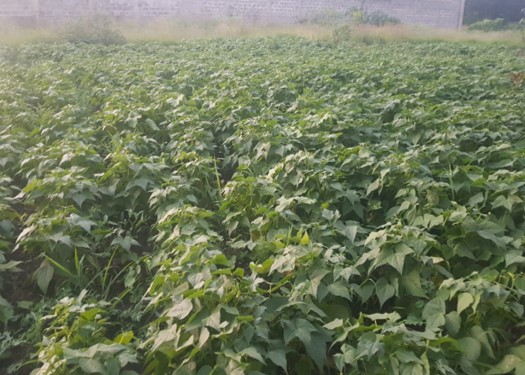
Waithera bean crop in the field
For farmers who have piloted the variety, the data tables tell only part of the story. The real proof comes when the harvest fills their bags. In Kiambogo, Gilgil, Nakuru County, farmer Lucy Wairimu says her first harvest from Waithera changed her expectations entirely. From just two kilograms of seed, she harvested about 180 kilograms – two 90-kilogram bags.
“I used to harvest under 30 kilograms from the same area,” she said. “This time I got two full bags. The difference was unbelievable.”
Lucy followed the instructions meticulously: she prepared her land to a fine tilth, mixed NPK fertilizer into the soil, and planted two seeds per hole at a spacing of 50 centimetres by 10 centimetres. Crucially, she began a rigorous pest and nutrition management regime ten days after germination, applying a starter foliar fertilizer and an insecticide to prevent the devastating bean fly.
“Bean fly lays eggs inside the stem. If it’s not managed early, the plant becomes stunted and gives nothing, “she added.
By day 40, pods had formed. Two weeks later, the crop was ready for harvest—and later sale, with demand exceeding supply.
Another farmer Rebecca Waruguru, from Gatuanyaga in Kiambu County describes a similar trajectory: “I got one kilo of the Waithera variety from the Agriculture Officer in September 2025. I was able to plant a half kilo, from which I harvested 20 kgs. I then went ahead and planted one and three-quarters kgs and harvested over 100 kgs. “She adds that the taste surpassed that of Wairimu and, importantly for her family’s comfort, produced no gas upon consumption. For Agnes Nyaguthii, from the four kgs of seed came 150 kg and has already begun sharing planting material with neighbours.
Scaling through farmers
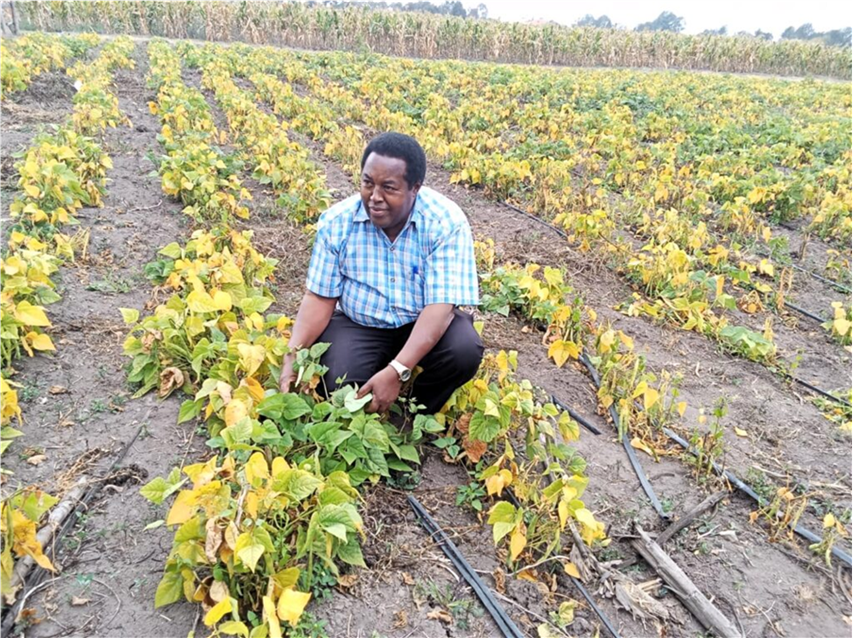
David Karanja, National Coordinator for Grain Legumes at KALRO, in a Waithera Bean Field
Recognising that a great variety is only as valuable as farmers’ ability to access it, KALRO and PABRA have developed an inclusive seed demand strategy to scale Waithera across Kenya. Rather than relying solely on conventional distribution channels, the partners are promoting the variety through a “last-mile” model built around champion farmers and county extension systems. The approach emphasizes peer-to-peer seed sharing, supported by structured training and monitoring from agricultural officers in counties such as Nakuru, Bomet, Elgeyo Marakwet, and Nyeri.
Breeder seed production has already been completed, and basic seed multiplication is underway. Seed is not yet widely available in agrodealer shops but is being accessed through pilot farmer groups and trained champions. Wider commercial rollout is expected in the June–September 2026 season as private seed companies join the system.
Conclusion
Across demonstration sites, what is becoming clear is that Waithera is not considered as an experimental crop, but as a replacement. The variety itself is proving itself as a transformative, carrying with it the promise of a more food-secure and prosperous future for Kenyan farmers and their families.
Cover Image: Magic Bullet: Waithera Bean Grain