
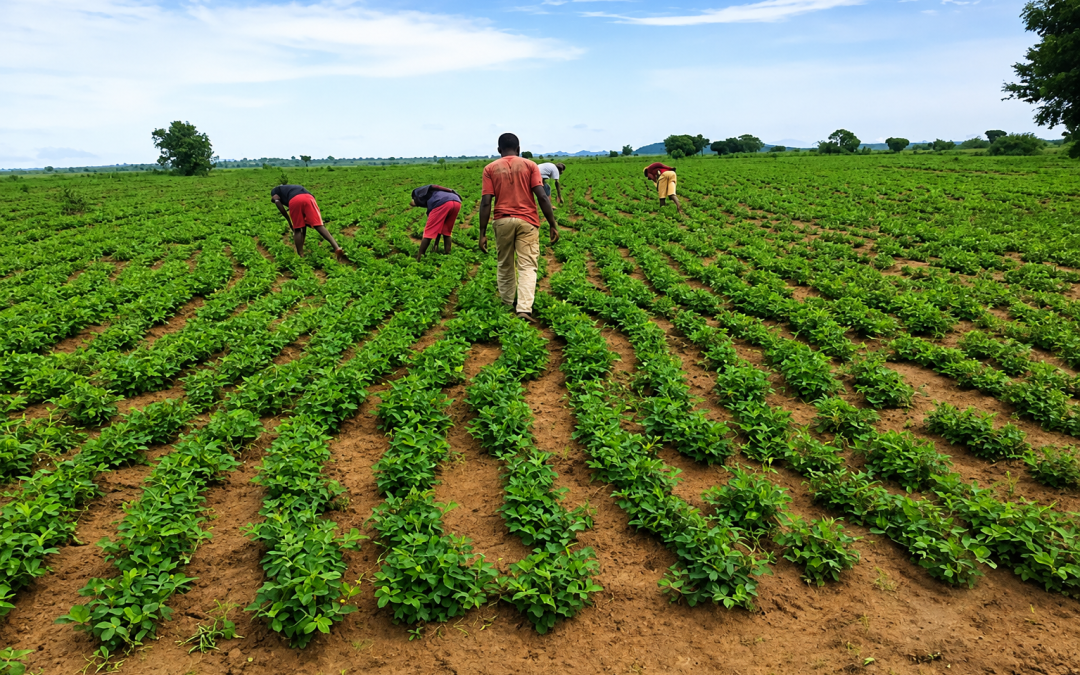
For years, Mohamed Hassan Matimba, a grain trader based in Nanyumbu District, Mtwara Region – Tanzania, sourced groundnuts from more than 150 smallholder farmers and a network of local collectors. However, poor grain quality and low production volumes continued to limit his business growth. In 2024, through the Accelerate Project, funded by Gates Foundation and implemented by The Alliance of Bioversity International and CIAT through Pan-Africa Bean Research Alliance (PABRA), TOSCI, TARI and CIMMYT, Matimba was introduced to Tanzanut 2016, an improved groundnut variety released by TARI Naliendele. He received only 25 kg of breeder seed as a starter package and planted it under challenging conditions, including late planting and prolonged drought. Despite these setbacks, he harvested about 140 kg, demonstrating the variety’s remarkable resilience and potential.
Encouraged by the results, Matimba stored the harvested seed and replanted it during the 2025/2026 season. The outcome was impressive, yielding approximately 7 tons of groundnuts. Farmers in the area quickly noticed the superior performance of Tanzanut 2016, particularly its high yield, early maturity, and resistance to rosette disease, a major constraint affecting groundnut production in southern Tanzania. As a result, many farmers began considering the variety as a suitable alternative to Mangaka 2009, Pendo 1998, Johari 1985 (tan colour), older varieties that are increasingly vulnerable to diseases.
Today, Matimba has become more than just a grain trader; he is an important catalyst for seed dissemination in his community. Using phone calls and personal visits, he actively informs farmers about the availability of Tanzanut 2016 seed. To make access easier, he offers both cash sales and seed exchange arrangements. Already, about 50% of the harvested seed has been distributed to farmers in preparation for the next planting season. Matimba’s journey in promoting improved groundnut varieties is taking shape and attracting increasing attention from farmers across the district. Building on the success of Tanzanut 2016, he is now requesting teaser samples of TARIKA 1 and TARIKA 2, newly released, tan-coloured groundnut varieties developed by TARI Naliendele in 2024. The varieties will be evaluated under Matimba’s coordination, allowing farmers to observe their performance and suitability under local conditions before wider dissemination. His experience highlights how a motivated private-sector actor can accelerate the adoption of improved seed technologies, strengthen local seed systems, and contribute to increased productivity and resilience among smallholder groundnut farmers in southern Tanzania.
Read more about Mohamed Matimba’s success story in this Publication on CG Space: Empowering local grain traders to drive seed system change: Lessons from Mohamed Hassan Matimba, a trader in Nanyumbu District, Mtwara, Tanzania.: https://hdl.handle.net/10568/185811.