
By Janviere Umurunji, David Muhawenimana, Yvonne Munyangeri, Eliud Birachi
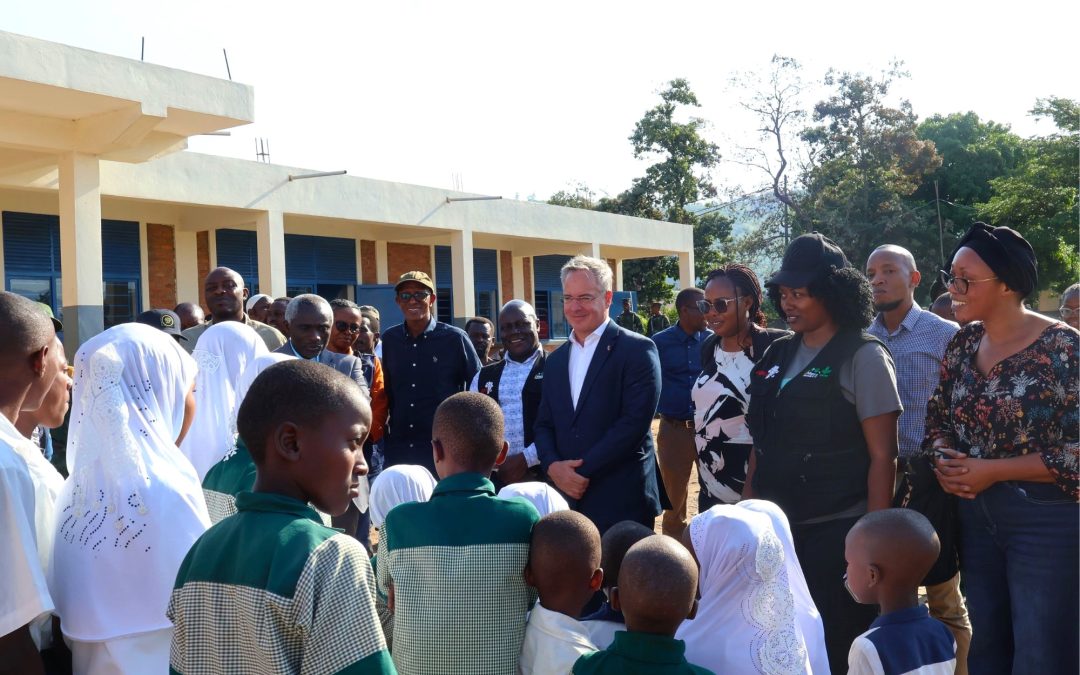
Hamimu Mbarushimana, a Head Teacher at GS Bugarama Cité School in Rusizi District in Rwanda’s Western Province, has learned to read hunger as easily as he reads a class register.
In his school of 2,716 learners, many children arrive in the morning having eaten nothing since the previous day. Some depend entirely on the school meal to get through the day. When food is uncertain at home, attendance, concentration, and even classroom discipline tends to follow the same pattern.
“Some children only eat once a day,” he said. “Since they receive lunch at school, these beans are very important in improving their nutrition.”
That reality is precisely what Rwanda’s new school feeding approach is trying to change, not by introducing unfamiliar foods or complex interventions, but by improving the nutritional value of what is already on the plate.
An initiative in full swing
On 26 May 2026, in Rusizi District, that approach moved from scattered school gardens and pilot plots into a formally launched national-scale program. The Scaling Sustainable School Feeding Innovation (3SFI) Project was officially unveiled in Western Province, bringing together government officials, researchers, diplomats, and development partners to consolidate what has already been unfolding in school gardens like Hamimu’s.
The project is funded by the Swiss Agency for Development and Cooperation (SDC) and implemented by the Alliance of Bioversity International and CIAT through the Pan-Africa Bean Research Alliance (PABRA) in partnership with Government of Rwanda. Its focus is deceptively simple: replace ordinary beans in school meals with biofortified, high-iron varieties that look and cook the same but carry significantly higher nutritional value.
3SFI targets 509 schools across Rusizi, Nyamasheke, and Karongi districts, reaching over 445,000 schoolchildren, many of whom rely on school meals as their most dependable source of daily nutrition.
Behind those figures sits a deeper problem: persistent iron deficiency and malnutrition among school-aged children, especially in rural areas where diets are limited, and household food insecurity is common. In such settings, school feeding is often the only consistent nutritional safety net available.
Six months in, the results are turning heads
When 3SFI Project Leader Dr. Eliud Birachi presented the project’s progress, the figures revealed a program scaling far faster than anticipated. For instance, what had been planned for 300 schools has already reached 509. Instead of 300 demonstration plots, there are now 1,901 across 48 sectors. In just six months, the project delivered 18.5 metric tons of high-iron bean seed, brought 300 hectares under cultivation, tested 283 soil samples, and applied 427 metric tons of lime to restore exhausted soils.
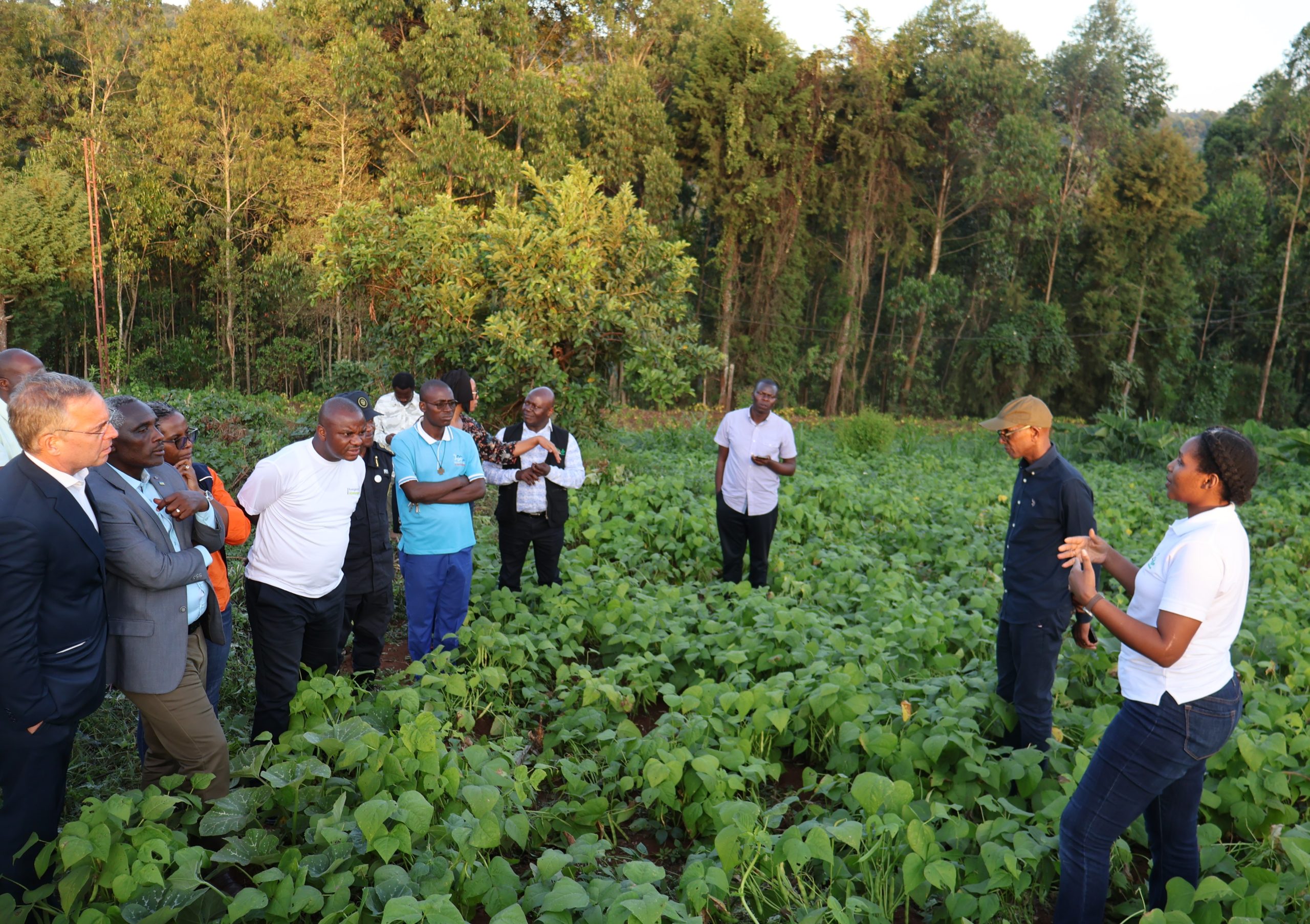
Seeing impact firsthand: Partners visit school gardens participating in the 3SFI Project
The implementation side has moved just as quickly: 1,110 school staff trained in agronomy, nearly a thousand trained in post-harvest handling, 607 storekeepers equipped to reduce storage losses, and 629 community-based agents working with households around participating schools. A harvest of about 427 metric tons of beans is expected in the coming weeks.
At GS Bugarama Cité School, those system-level figures translate into something more immediate: a school trying to guarantee that learning does not collapse on an empty stomach.
Beyond nutrition, the school has also seen practical benefits. Even under below average rainfall, yields have improved, and food procurement costs have begun to fall—an important detail for schools operating on tight budgets.
Bean varieties built for farmers and consumers
The backbone of this shift is a set of high-iron bean varieties developed through long-term research by the Alliance and PABRA networks. For Global Bean Program Leader at the Alliance and PABRA Director, Jean Claude Rubyogo, the value of these varieties lies in their ability to solve multiple problems at once.
“These beans are helping combat malnutrition while improving farmers’ livelihoods through higher yields, reduced cooking time, lower energy use, and stronger resilience to climate change, diseases, and pests,” he said.
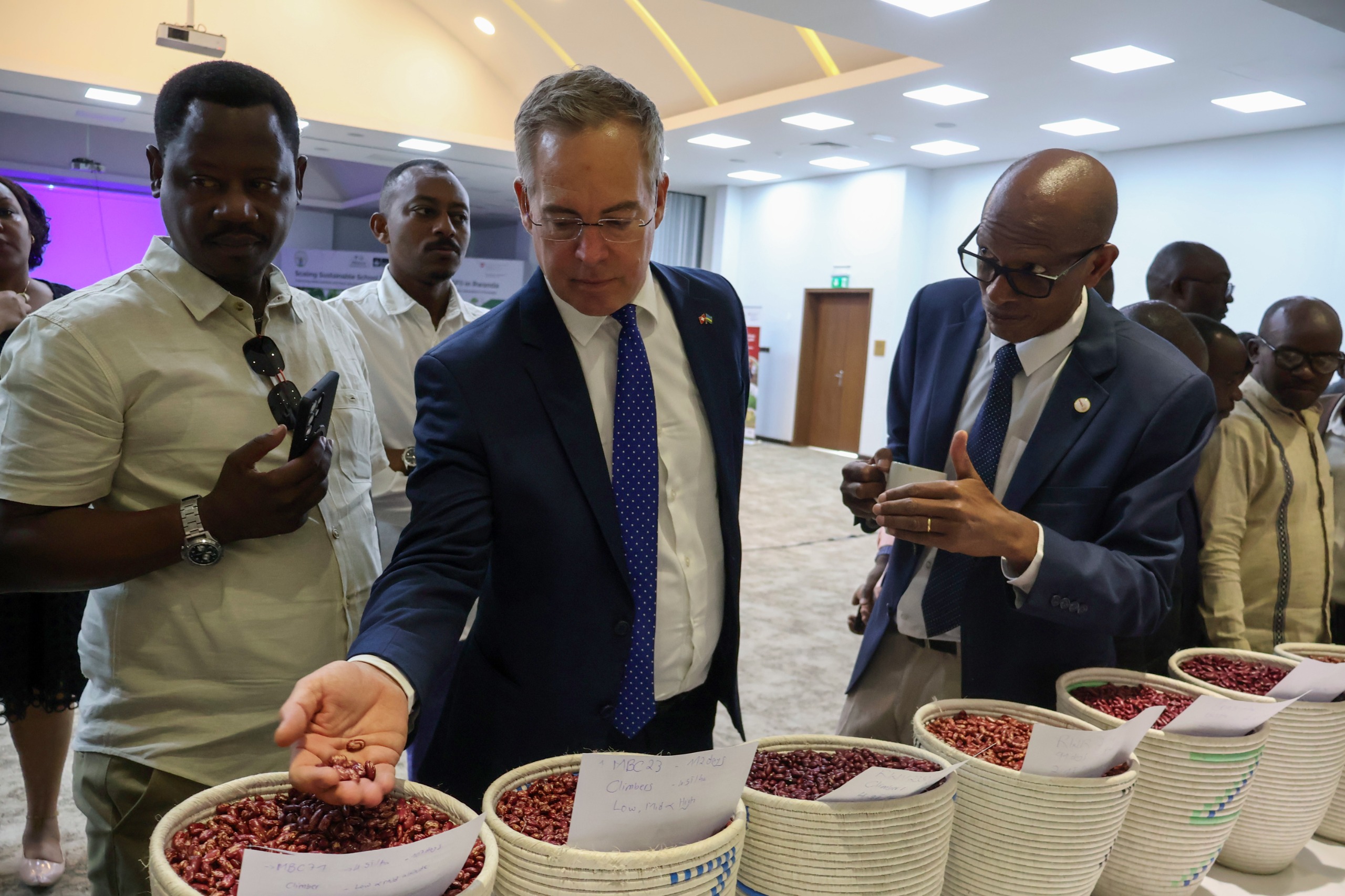
Rubyogo (Right) sharing insights on improved bean varieties with Deputy Head of Mission at the Swiss Embassy in Rwanda Ueli Mauderli (middle) during the Project launch
That combination matters in rural Rwanda, where food choices are shaped as much by fuel costs and climate variability as by nutrition science. The beans are designed to fit existing diets and farming systems while quietly improving outcomes on both sides of the supply chain.
Rubyogo also emphasized that schools are not the end point of the system, but the entry point. Surrounding farming households are being integrated into production networks that supply school kitchens, linking nutrition goals with rural livelihoods.
“This project is not just about schools,” he said. “We are also looking at parents who are around schools.”
Swiss commitment
Development partners see the same logic playing out at policy level. Deputy Head of Mission at the Swiss Embassy in Rwanda, Ueli Mauderli, underscored the broader significance of the project, which he says, aligns with Rwanda’s national development priorities while also responding to global commitments on nutrition, education, and sustainable food systems.
He also pointed to its climate dimension, noting that drought-tolerant bean varieties and soil conservation practices such as mulching and composting are built into the model—an attempt to protect nutrition gains in an increasingly unpredictable climate. “The initiative is expected to contribute to better education outcomes by improving children’s health, school attendance, and academic performance,” he said.
Government calls for national-level scaling
Rwandan Government officials used the launch to push the conversation beyond pilot status and toward national scale.
Permanent Secretary in the Ministry of Agriculture and Animal Resources Dr. Olivier Kamana described the project as already strengthening school feeding systems, while supporting farmers and climate-smart agriculture, calling for evidence from Western Province to guide broader rollout.
“The initiative is helping build stronger local food systems while contributing to better nutrition, improved learning outcomes, and more resilient communities across Rwanda,” said Kamana.
On his part, Richard Kubana, who is Director General for Community Mobilization at the Ministry of Local Government, framed the intervention within Rwanda’s Vision 2050, stressing that nutrition is not only a health issue but a foundation for long-term human capital development.
He also highlighted an often-underemphasized reality: girls are disproportionately affected by iron deficiency, making school-based nutrition interventions particularly significant for gender equity and future opportunity.
At district level, Rusizi Mayor Phanuel Sindayiheba pointed to another practical outcome. When schools produce part of their own food, they reduce procurement costs—savings that can be redirected toward learning materials, infrastructure, and daily school operations.
Taken together, the 3SFI project is being positioned not as a standalone nutrition intervention, but as a functioning system that links agriculture, education, health, and climate resilience. In schools like GS Bugarama Cité, where hunger and learning have long competed for space in the same classroom, the change is already beginning to show up in the simplest measure of all: whether a child can concentrate long enough to learn.
Learn more about 3SFI: https://youtu.be/LY9s1Z9zoi8
Cover Image: Witnessing nutrition taking root: Proud learners at GS Bugarama Cité welcome a 3SFI Project delegation