
By Yohane Chideya, Eunice Magwaya, Wilson Nkhata, Dennis Ongo’r, Jean Claude Rubyogo
When Grace Mijiga Mhango talks about Afriseed, she does not start with numbers or hectares. She starts with a simple realization she had nearly a decade ago. “If we want to supply the markets we are targeting, we cannot do it as Malawi alone,” she says with a smile. “Besides, as a business, without seed, there is no sustainability.”
That realization, back in 2016, is what pushed her to design what she calls an inclusive business model—an approach that would link smallholder farmers, especially women and youth, directly into seed production and regional markets.
At the time, the challenges were many. Access to clean planting material was unreliable. Markets were not clearly defined. Seed production was often ad hoc, with little planning or coordination. “We were producing and selling without a proper plan,” Grace recalls. “The market was not organized, and information was hard to get. Without information, you cannot plan a business.”
Afriseed’s transformation accelerated when Grace engaged with the Multi-Stakeholder Platform (MSP) supported by the Alliance of Bioversity International and CIAT through Pan Africa Bean Research Alliance (PABRA). The platform brought together breeders, researchers, traders, and seed companies, creating a space where information, technical advice, and market intelligence could flow more freely. “It helped me a lot,” she says. “Not just with seed, but with exposure to regional markets and better planning. Even now, through the WhatsApp groups, we can solve problems almost instantly. Information flows much faster.”
With stronger technical backing and better information, Grace shifted her business strategy. Instead of producing seed and hoping it would sell, she started with the market and worked backward. Through research, her team found that although Malawi had more than 40 bean varieties, only three or four had strong, consistent demand. Among them were NUA45, white haricot beans, and sugar beans, which were in high demand in regional markets such as South Africa.
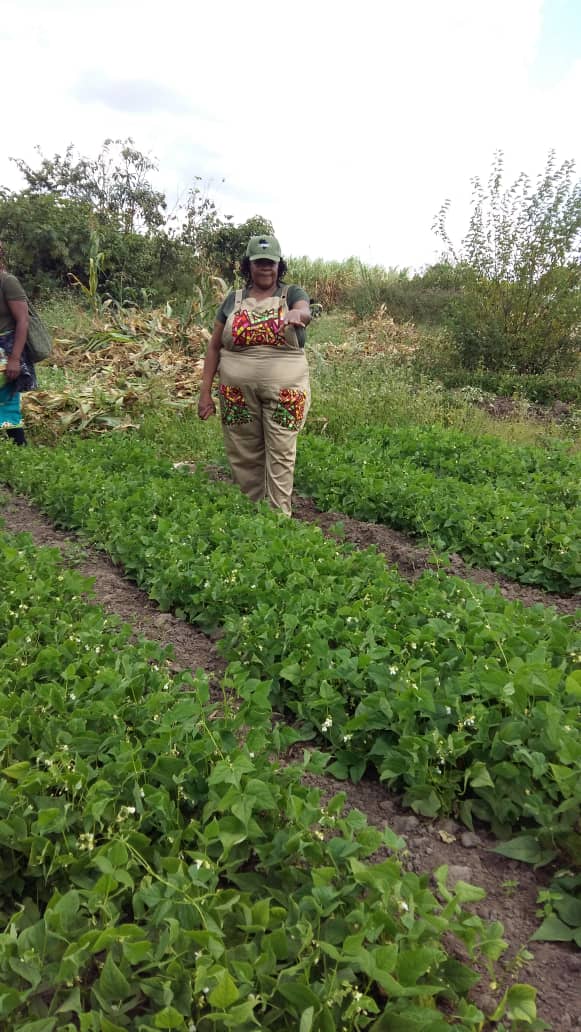
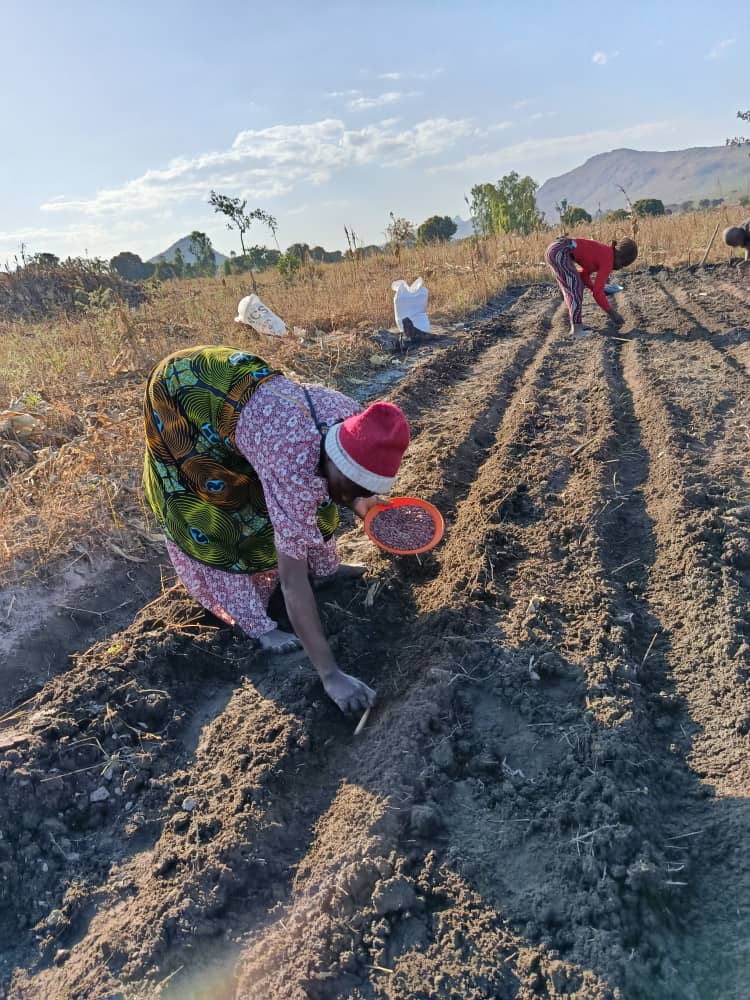
Grace with some of the farmers she works with
“South Africa has a canning industry and big retail chains,” she explains. “If you supply what they want, that market will always be there.”
This market-led approach became the second pillar of her business, alongside the inclusive production model. The third pillar was aligning production across countries—using Malawi as a seed hub, while encouraging grain production in places like Mozambique and Tanzania, where land is more abundant but seed systems are weaker. “If we strengthenthe seed system, and our neighbors produce the grain, then the whole value chain becomes more sustainable,” she says.
What began as a response to seed scarcity has evolved into a structured regional seed business model, proving that inclusive systems can also be commercially competitive.
When clean seed changes the game
The real turning point came when CIAT provided small quantities of breeder and basic seed in April 2023.The organization provided Afriseed with just 800 kilograms of starter seed. It included 100 kilograms of NUA45 breeder seed, 100 kilograms of VTTT924/4-4 (hereafter referred to as VTTT9) breeder seed, and 500 kilograms of NUA45 basic seed that was passed on to youth groups.
Within one season, that modest package unlocked more than 4.4 tons of pre-basic seed—2.5 tons of NUA45 valued at USD 8,750, and 1.9 tons of VTTT9 worth USD 6,563. Another 200 kilograms of certified NUA45 seed was recovered from the youth group and passed on to another farmer organization, adding another USD 600 in value. In total, more than USD 15,000 worth of high-quality seed was generated in just a few months.
“That was the moment we saw the real power of clean seed,” Grace adds. “A small investment can grow into something much bigger.”
The following main season, from December 2023 to April 2024, Afriseed scaled up production using the pre-basic seed. NUA45 was planted 25 hectares, producing about 50 tons of basic seed worth roughly USD 150,000. VTTT9 covered 18 hectares and yielded 27 tons, valued at USD 81,000. In one season alone, the company generated more than USD 230,000 worth of basic seed.
The impact soon spread beyond Malawi. In 2025, CIAT used Afriseed as a regional hub to strengthen seed systems in Mozambique and Eswatini. Seed was donated for scaling up—200 kilograms of NUA45 pre-basic seed to Eswatini, 100 kilograms of Sugar 131 to Mozambique, and another 200 kilograms of Sugar 131 within Malawi. At the same time, Afriseed accessed 10 tons of clean planting material, which it sold to the Mangwana Project in Mozambique for USD 35,000.
Today, the results are even more striking. CIAT- and PABRA-supported systems are expected to produce more than USD 1 million worth of certified seed across three countries in the current season. Malawi alone is projected to produce 120 metric tons of NUA45 certified seed, worth about USD 360,000. Mozambique is expected to produce 100 tons of NUA45 and another 100 tons of Sugar 131, together valued at USD 600,000. In Eswatini, 2.5 tons of Sugar 131 basic seed are already in production.
An inclusive system for women and youth
Behind these numbers are hundreds of farmers who are now part of the system. In Malawi, 210 farmers are currently involved, with women and youth making up 80 percent of participants. Another 100 farmers are engaged in Mozambique, and Eswatini is preparing to bring in at least 50 more with the same inclusive approach.
For Grace, those farmers are the real story. “When you see the youth working with these seeds, you see hope,” she says. “Beans can be a solution for poverty, especially when farmers are producing seed. The value is higher than grain, and the opportunities are bigger.”
Her team has also learned hard lessons along the way. In the early years, seed was often given to farmers for free, and many did not return it after harvest, breaking the multiplication cycle. “If you lose seed at the breeder level, you lose the program for years,” she explains.
So Afriseed changed its approach. Now, farmers who want to participate in seed production must invest in seed, paying 50 percent upfront, with the rest structured as a loan. The change has improved discipline and results. “When farmers invest, they expect a return, and they take better care of the seed,” she says.
A regional vision for sustainable bean markets
Climate variability remains a challenge, with erratic rainfall affecting production in recent years. To adapt, the company is shifting more production to irrigated winter cropping and investing in better systems, especially in Mozambique, where demand is strong but seed systems are still developing.
Even with these challenges, Grace remains focused on the bigger picture: building a regional bean economy anchored in strong seed systems. Her plan is to continue strengthening seed production in Malawi while using neighboring countries for large-scale grain production, ensuring steady supply to markets like South Africa.
Looking back, she sees CIAT and PABRA as catalysts that helped turn a small seed initiative into a regional business. “It’s all about the support we have been getting,” she says. “The clean seed, the technical advice, the platforms, and the exposure has changed everything.”
What started as a small, inclusive seed production idea in 2016 has now grown into a regional system generating over a million dollars’ worth of certified seed, engaging hundreds of farmers, and opening new markets across southern Africa. ForGrace, it is proof that when science, markets, and inclusive business come together, small seeds can grow into something far bigger than expected.