
By Warren Arinaitwe, Dennis Ong’or, Jean Claude Rubyogo
On a family farm in Kenya, Mercy Loko, a young farmer from Katumani in Kenya, grew beans the way their parents had always done; small-scale, low inputs, and without much technical guidance. The orchard on the side of the farm offered fruit seasonally, but it was never treated as a serious business. Like many young farmers, Mercy wanted to do more but lacked access to improved knowledge, technologies, and inspiration to scale beyond basic subsistence production.
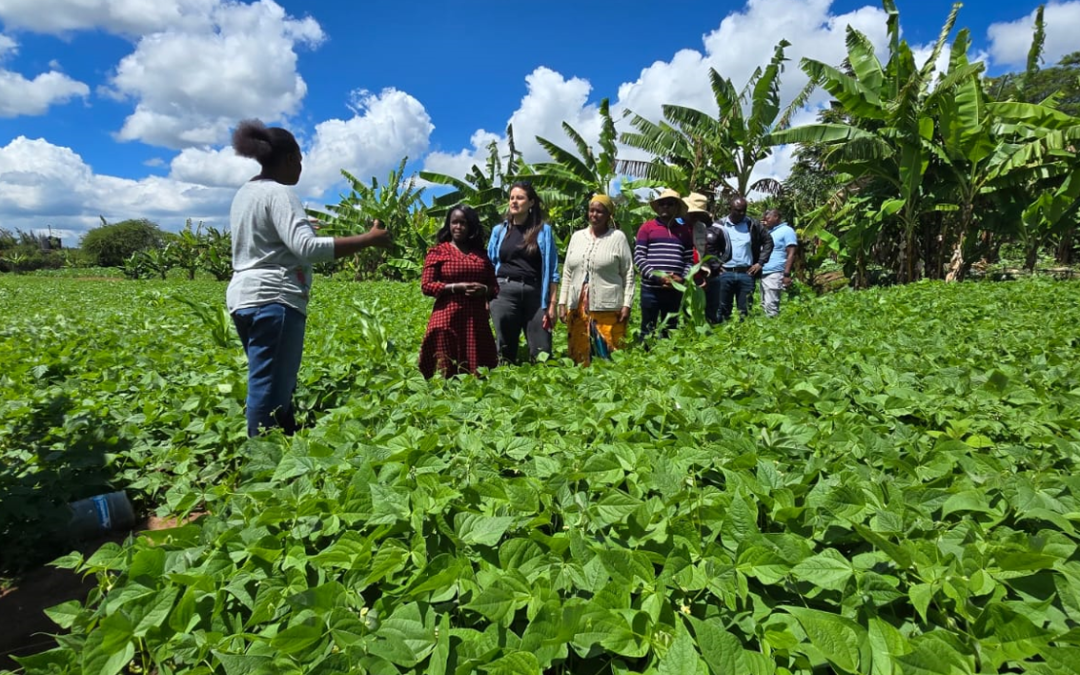
That situation began to change with support linked to the BRAINS Initiative through local partners, when the farm was introduced to a series of trainings and on-farm demonstrations led by the Kenya Agricultural and Livestock Research Organization (KALRO). Mercy describes this period as a turning point, as she gained access to valuable information, encouragement, and practical farming guidance. With this support, she and her family restarted farming on a one-acre piece of land after a long period of decline. Despite facing abiotic challenges, their harvest steadily improved—from 500 kg in 2023, to 1,200 kg in 2024, and 1,500 kg in 2025. Encouraged by these results, Mercy expanded her farm to seven acres, which are now actively under bean production.
What began with food crops and beans soon expanded into new opportunities. “The good thing is we did not force bees into our farm; they came on their own,” Mercy explains. After noticing increased bee activity, she introduced four beehives, placing two on a separate plot. With technical support from icipe, this opened a new source of income while also improving pollination for her crops. From the first hive that was colonized, Mercy harvested six kilograms of honey and is expecting another harvest early this year from the remaining three hives. Today, she sees farming not as a single activity, but as an integrated system that offers multiple opportunities for growth and income diversification.
The impact of this change has gone beyond her own farm. As her produce reached the market, Mercy began receiving calls from people interested in farming but unsure where to start. Drawing from her own experience, she has already encouraged about eight other farmers, particularly young people, who started growing high-iron bean varieties as a rotation crop.
Having progressed from one stage to another, Mercy is now looking ahead. Beyond her current value-addition activities in garlic and hibiscus, she plans to venture into bean and honey processing. She believes that with continued support from BRAINS, she will be able to enter these profitable enterprises. As she puts it, “when farmers receive the right information and encouragement, they don’t just grow crops, they grow confidence, direction, and ambition.”
Cover Photo: Mercy with partners at her farm in November 2025