
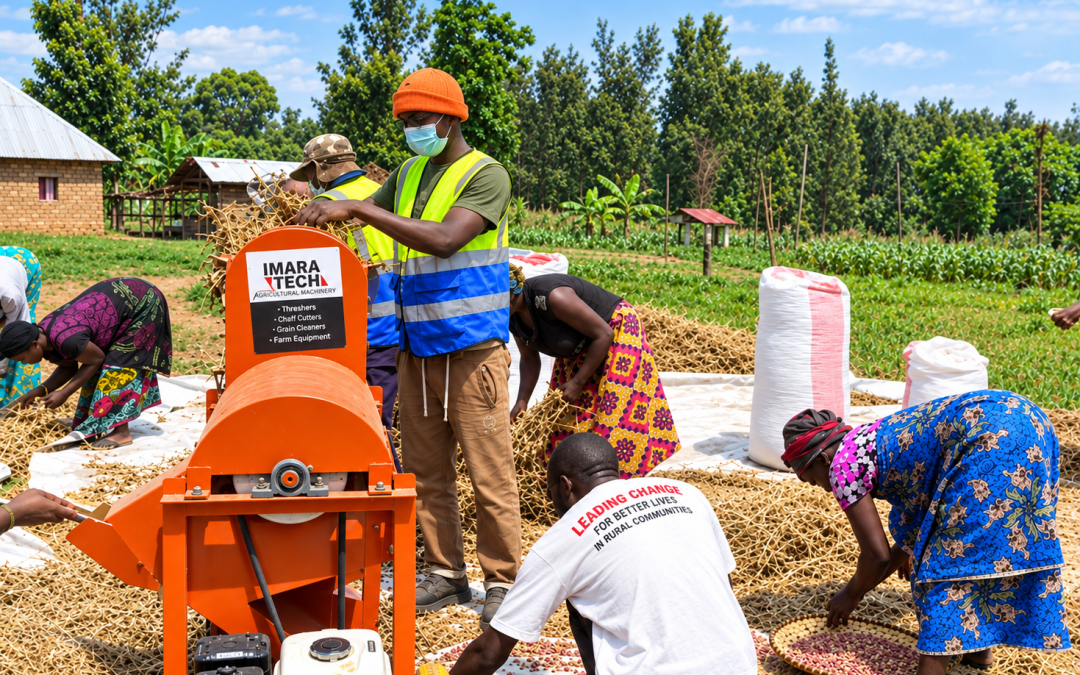
By Paulin Njingulula, Nepomuscene Ntakumazine, Adebola Awotide, Lydie Mulonda, Napoleon Kanjuju, and Jean Claude Rubyogo
Since time immemorial, harvest season for women farmers in Kabare Territory, in eastern Democratic Republic of Congo (DRC) meant long hours of exhausting work, money spent on hired labor and, sometimes, borrowing to get the harvest ready for market. Threshing beans, maize, soybeans and other crops by hand is physically demanding and time-consuming. Paying someone to do the work offers some relief, but at a cost many women struggle to afford.
“For 100 kilograms of grain, we pay $10, and it takes at least four hours,” says Julienne, a member of the Umoja cooperative. As the years pass, the work becomes even harder. “We’ve always done this, we have no choice. Now we’re harvesting, our strength is waning with age. We need to hire labour, young boys to help us thresh the beans. We were forced to borrow money for this and, unfortunately, what we’re going to harvest will not give us enough money to repay it,” she says.
For Julienne and many other women, the challenge has been finding a way to make their harvests pay without exhausting their bodies or stretching their finances. Now, a simple piece of agricultural equipment is helping change that reality. Through the Beans for Women Empowerment (B4WE) Project, 100 multi-crop threshing machines have been provided to producer organizations to reduce the physical burden of post-harvest activities and strengthen bean production. B4WE bought the machines from Imara Tech in Tanzania and that each cooperative contributed 20% of the purchase price. The initiative reached 78 cooperatives across three provinces: 35 in South Kivu, 34 in North Kivu and nine in Tanganyika. Project figures indicate that 42,845 people have benefited, including 29,962 women and 12,523 men.
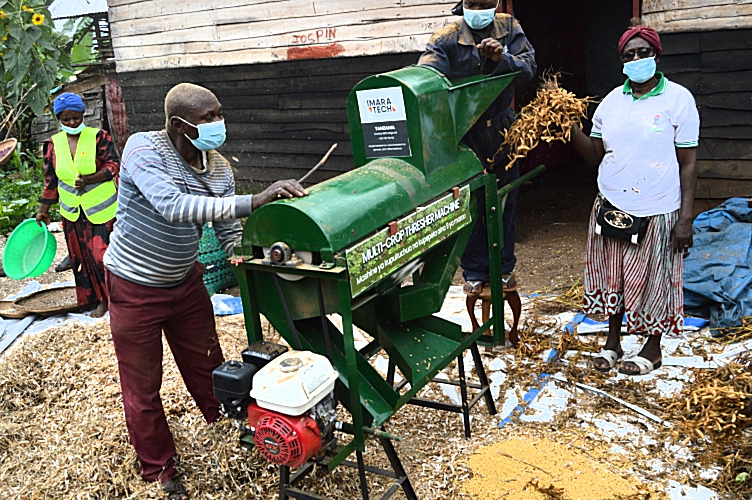
Threshing machines like this are empowering women in Eastern DRC
The machines can thresh between 500 and 800 kilograms of crops using just one liter of fuel, significantly reducing the time and labor required compared with traditional methods. They can also process a variety of crops, including beans, maize, rice, sunflower, wheat, soybeans, groundnuts and sorghum.
For Marie Totoro, from Musuzangabo in Miti, the benefits go beyond efficiency. The training provided through the project has enabled women to operate the machines themselves, challenging the perception that such equipment is primarily men’s responsibility.
“Generally, the use of this type of machine is often handled by men. We women were not often interested in it. But this time, with the project, we were all taught how to operate the machine, to the point that we can use it even without a technician present, when we need to. This gives us more respect in our community when we do it,” she says.
For Marie and her fellow cooperative members, learning to operate the equipment has brought greater independence and confidence. Women are no longer simply beneficiaries of agricultural technology but are also gaining the skills to use and manage it.
Even Leontine Byakuwa of the Walio Baki cooperative in Kavumu, is seeing the impact is in her household. Since the threshing machine arrived, she has been able to save money that would previously have gone towards hiring labor. “To date, I have already saved $30, which I just used to buy a piglet,” she says.
Her plan is to raise the animal and eventually use the proceeds to help pay for her children’s education. It is a small investment with a bigger ambition. Money once spent on threshing has become an opportunity to build an asset and plan for the future.
Her experience demonstrates how reducing post-harvest costs can give women greater control over their resources and create opportunities to invest in their families’ well-being. The machines are also generating income for cooperatives that rent them out to other farmers. According to project figures, 13.2 tonnes of crops had been threshed through these rental services, generating $470 in revenue. This arrangement allows cooperatives to earn additional income while extending access to farmers beyond their membership.
Protecting trees for environmental sustainability
The benefits are not limited to finances and productivity. For Sifa Mudumbi of the Kazi Mbele cooperative, the machines are also helping ease pressure on the environment. She explains that people hired to thresh beans traditionally cut down young shrubs and trees to obtain materials used in the process. In an area already experiencing tree loss due to demand for construction materials and firewood, this adds to the pressure on local vegetation.
“The pressure on cutting down young trees has greatly decreased thanks to the use of the threshing machine,” she says.
Although the machines cannot solve deforestation on their own, they offer a practical alternative to a traditional practice that contributes to the problem. For farming communities whose livelihoods depend on the land, reducing pressure on natural resources is another reason to embrace more efficient agricultural methods.
A machine that brings communities together
Perhaps one of the most significant changes has been the way the equipment is bringing people together. In eastern DRC, where insecurity and conflict have strained relationships between communities, shared resources can create opportunities for cooperation. Jeanette, a member of the Agriforce cooperative, says renting out the machine has become a way of extending solidarity beyond the cooperative.
“Owning a threshing machine or renting its services to other producers in the region is becoming a way for us to practise solidarity, a way to strengthen our community ties through mutual assistance,” she says.
She recalls that even farmers with whom members previously had disagreements now come to have their harvests threshed. “Today, even people with whom we used to have conflicts come to have their harvest threshed, and we welcome them with joy.”
The machine cannot resolve the deeper causes of conflict, but it gives people a practical reason to work together. By sharing a service that meets a common agricultural need, farmers can build relationships around cooperation rather than past disagreements.
Beyond the harvest
For the women of Kabare, the threshing machines represent much more than a faster way to process crops. They are helping reduce physical strain, free up money for other priorities, develop women’s technical skills, generate cooperative income and reduce pressure on young trees.
They are also creating opportunities for communities to support one another despite the challenges they face. For Leontine, progress means a piglet that could help finance her children’s education. For Marie, it means the confidence to operate machinery independently. For Sifa, it means less pressure on local vegetation. And for Jeanette, it means welcoming farmers from outside her own circle and strengthening ties through shared work.
The machines have made a demanding agricultural task easier. More importantly, the experiences of these women show how practical support, combined with training and collective ownership, can strengthen livelihoods and open doors to wider social change. In eastern DRC, the harvest is still hard work. But for these women, it is increasingly becoming an opportunity not just to produce food, but to build a more secure future for their families and communities.