
By Dennis Ong’or, Warren Arinaitwe, Jean Claude Rubyogo
If you ask Lucy Wairimu Mbugua about beans, she does not start with the technical details or yield figures. She starts with the weather. “Our seasons are not the same anymore,” she says, recalling years when her beans dried up in the field or failed to fill the grain. As secretary of Ushirikiano Women Group in Kiambogo, Nakuru County, Kenya, Lucy had watched many women struggle the same way – planting traditional varieties with hope and harvesting with disappointment.
That outlook began to change when the BRAINS Project introduced a new bean variety, SER 404, locally known as Waithera, through socio-technical innovation bundles that combined improved seed with practical training. Rather than simply distributing seed, the initiative equipped Lucy and 106 women in her group with hands-on skills through training sessions and on-farm demonstrations led by the Kenya Agricultural and Livestock Research Organization (KALRO). They learned proper spacing, timely planting, appropriate fertilizer use, and integrated pest management. For the first time, farming felt less like guesswork and more like a skill they were steadily mastering.
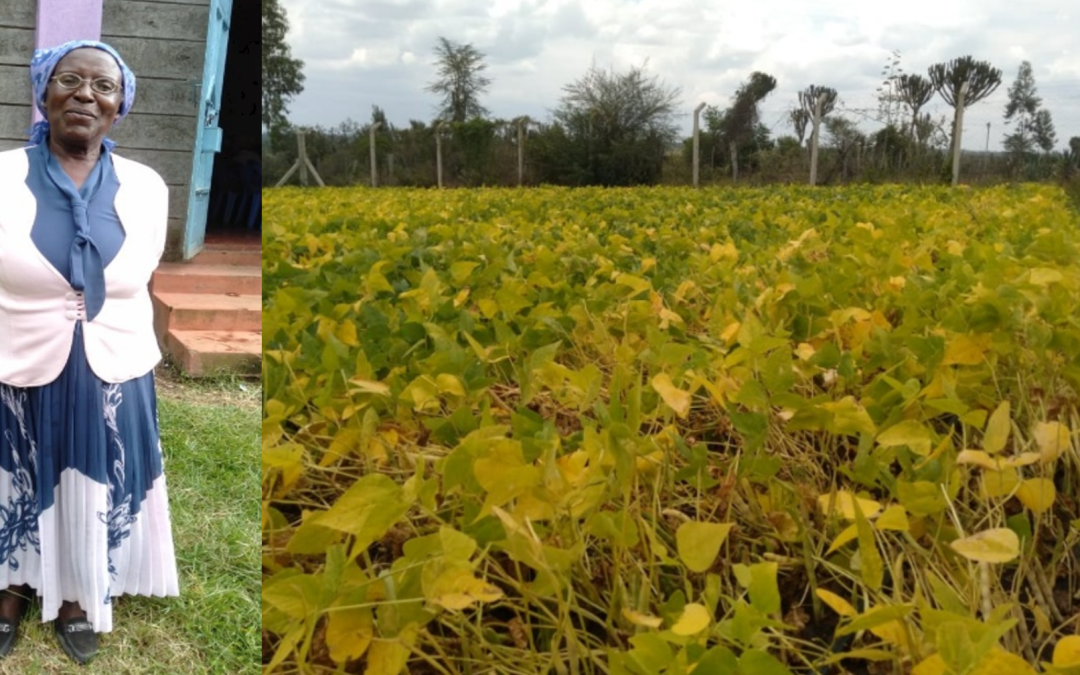
Then came the real test: performance in the field. Lucy planted just one kilogram of Waithera and harvested 24 kilograms. In the following season—drier and more challenging—she planted 15 kilograms and harvested more than 100 kilograms. While other varieties shriveled under severe drought, Waithera held on. “The first time I planted just one kilo of Waithera, I harvested 24 kg. When I planted 15 kg in the second season, which was drier than expected, I got over 100 kg,” she explains. The difference reshaped how Lucy viewed her farm—not as land that worked against her, but as land that could sustain her.
Encouraged by the results, Lucy sold part of her harvest as seed to 27 women in her group, enabling them to plant Waithera during the March–April–May 2025 season. Together, the group harvested approximately 1.8 metric tons. Building on this success, they planted Waithera again in the October–November–December season, targeting a harvest of at least 1.5 metric tons. For the first time, Ushirikiano Women Group has also secured formal market links with buyers such as Smart Logistics Solution and Cherubet Foods.
Linked to emerging bean–fruit–insect innovation bundles in her region, Lucy is now planning the next step: expanding Waithera cultivation into neighboring Nyandarua County while integrating beekeeping to diversify income. “Waithera has shown me it can handle our weather. I know my farm will support me better in the coming years,” she says. Her journey shows how climate-smart varieties, combined with practical knowledge and market connections, are helping women farmers move beyond trial plots toward resilient, market-oriented farming systems.
Cover Photo: Lucy Wairimu Mbugua and her Waithera bean farm